
2025 Activations Overview
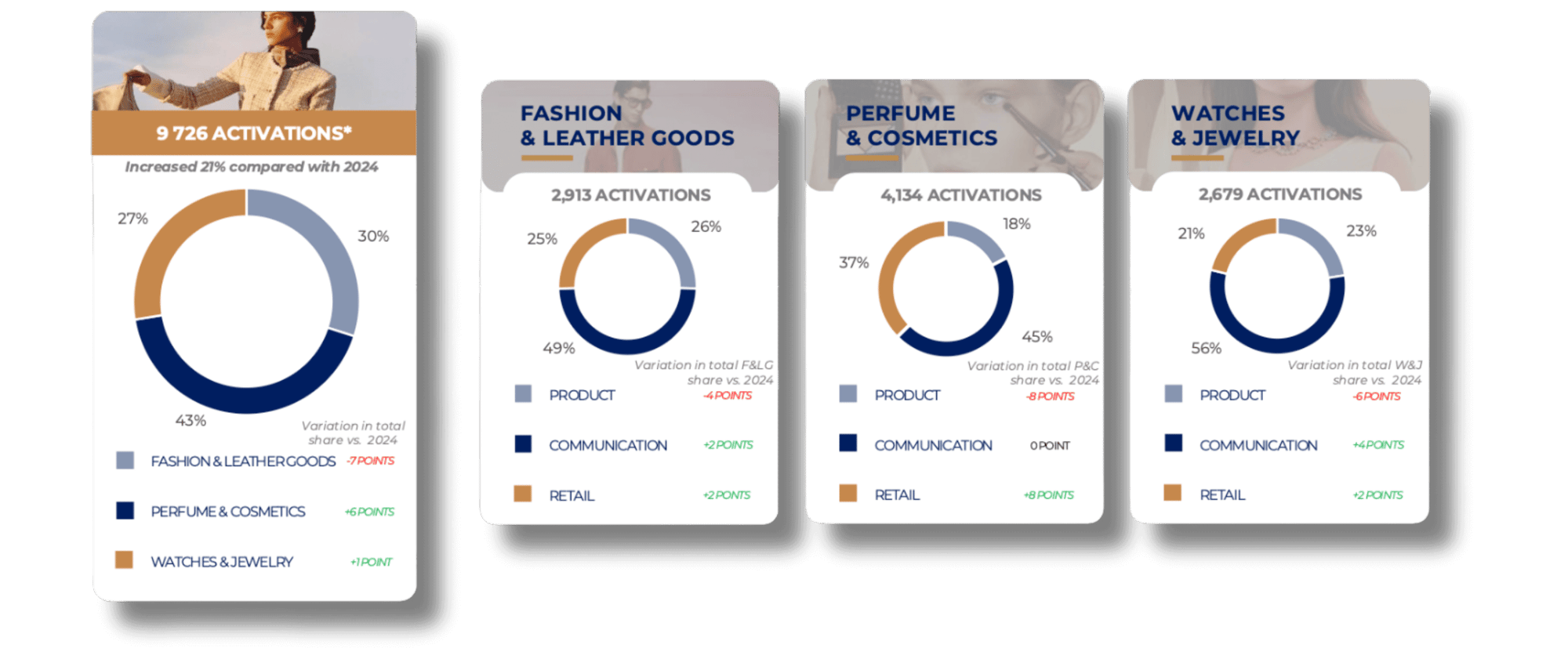
In 2025, total activations increased by 21%, primarily due to higher global retail and communication initiatives. This growth reflects a shift as brands are favoring localized initiatives over global activations especially in retail, where the volume of activations increased across all segments. Perfume & Cosmetics sector led the growth, recording the highest year-over-year increase in activation count and becoming the top sector in terms of activation volume for 2025.
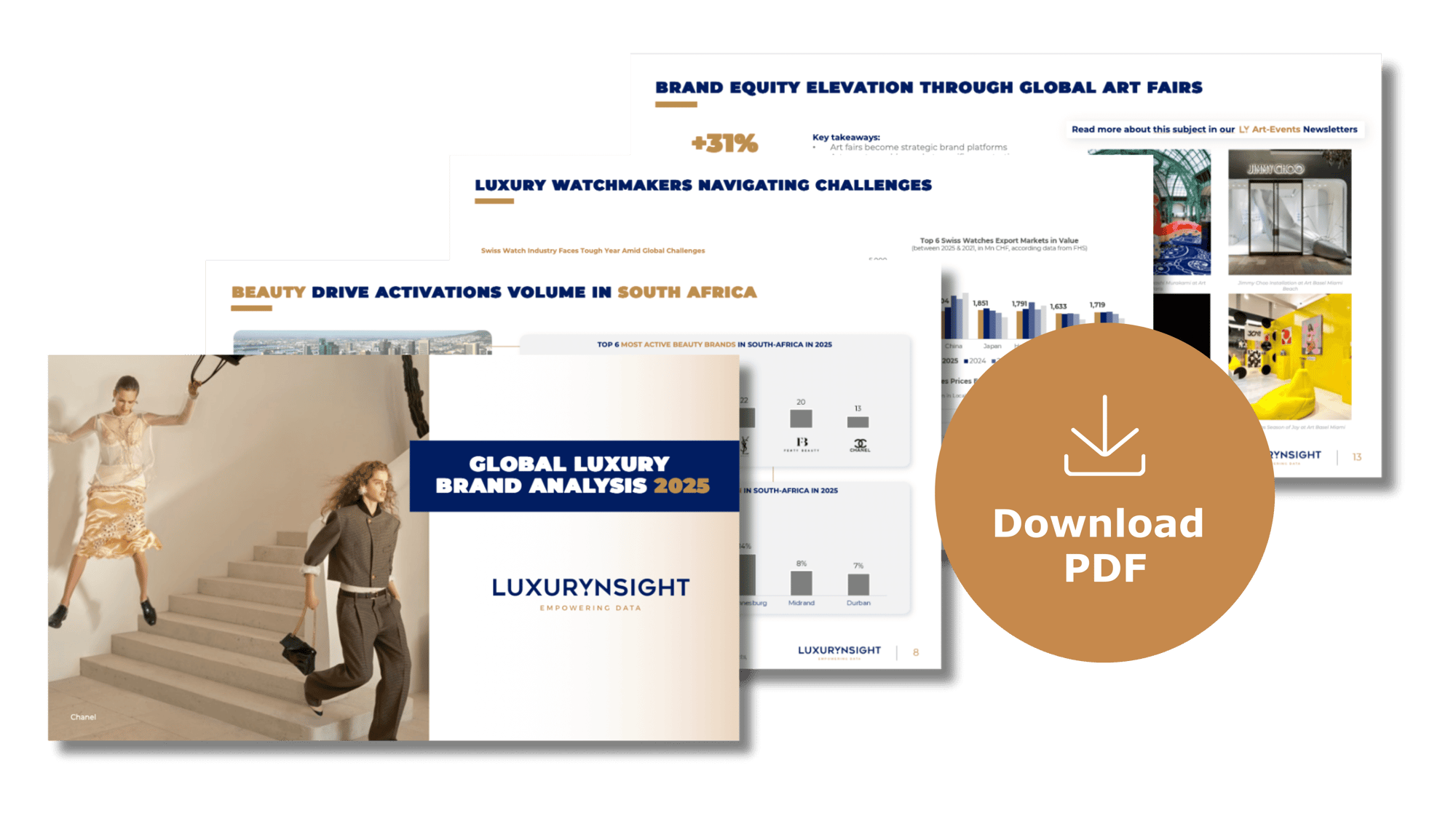
With this report, gain critical intelligence on how leading brands are navigating pricing pressure, cultural expansion through sports and cinema, and diverging regional momentum, powered by LY Watch's competitive intelligence and LY Trends' consumer demand forecasting.
KEY TAKEAWAYS
- Activation Growth Amid Normalization: Total monitored brand activations increased by +21% year-over-year in 2025, despite the luxury market entering a phase of normalization with personal luxury goods projected at €358B. Growth was heavily back-weighted, with H2 activations surging +46% versus H2 2024, reaffirming the strategic centrality of the year-end cycle.
- Sector Mix Realignment: Perfume & Cosmetics emerged as the dominant sector by volume, recording +43% growth and accounting for 43% of all activations. Growth was almost entirely retail-driven (+8pts globally). Fashion & Leather Goods contracted -1% globally and more sharply in China (-10%), while Watches & Jewelry delivered a stronger performance with +24% growth, driven by intensified communication strategies.
- Localization Over Globalization: Localized activations expanded by +40% while global initiatives declined -1%, signaling a structural rebalancing of brand strategies toward market-specific initiatives. In H2 alone, region-specific activations outpaced global ones by a significant margin (+65% vs. +21%), confirming that precision targeting is replacing broad-reach global campaigns.
- Regional Growth Divergence: MEA emerged as the fastest-growing region (+105%), led by South Africa (+245%), Saudi Arabia (+141%), and Qatar (+133%). North America posted equally remarkable growth (+102%), driven predominantly by Watches & Jewelry (+397%). China remained the largest market by activation volume despite more modest growth (+16%), while LATAM (+59%) and APAC (+79%) consolidated their positions as high-momentum emerging luxury hubs.
- Cultural Expansion as Strategic Lever: Luxury brands meaningfully broadened their cultural footprint in 2025, with main sponsor partnerships rising +52% and movie product placements surging +133%. Brands shifted from passive sponsorship toward active narrative participation — exemplified by IWC's integration into F1: The Movie and Gucci's cinematic debut with The Tiger — using entertainment, art fairs, and branded podcasts to deepen cultural authority and protect long-term brand equity.
- Pricing Pressure and Portfolio Discipline: Average luxury bag prices rose +3.3% globally, yet local price increases translated into negative euro-denominated returns in key markets due to adverse FX movements, exposing structural margin challenges. Leather goods entered a sharper correction phase, projected to decline -5 to -7% over the year. In response, brands expanded mid-range offerings and revised entry price points, while beauty groups pivoted from portfolio breadth toward capital efficiency, with the Kering-L'Oréal strategic alliance at €4B epitomizing this new discipline.